Why teachers leave

Teachers enter teaching full of enthusiasm – knowing they have an opportunity to affect the lives of many over their time in the classroom.

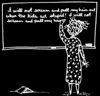
Time and circumstance often wreak havoc on these idealistic goals.  The teacher in the following YouTube video (Ellie Rubenstein) eloquently expresses what teachers across the nation are feeling these days.  Her passion for teaching can’t be denied.  Ellie’s video has gone viral – she is enthusiastically supported by hundreds of thousands across the nation.

Readers, what are your thoughts on the state of public education today?  Do you share or not share Ellie’s views?  Why or why not?

Why teachers teach

!cid_3172757604_646320   I recently read an article written by a college student who is reconsidering her decision to become a teacher.  While her heart seems to be in teaching, those around her are persuading her to pursue a more prestigious, higher salaried career.  In other words – a “real profession” that is worthy of the cost of a college degree.

The question then arises – why do teachers teach?  It certainly can’t be for the salary.  Teachers are underpaid and overworked.  It can’t be for respect.  Teachers are often falsely charged as being the “problem” with education.  It can’t be for the prestigious working conditions.  Many teachers work in anything but.  Why then do we see teachers endure these conditions year after year not closing the door on education to pursue a more self-satisfying, lucrative career?  The answer must lie in the altruistic nature of teaching and the strong sense of duty most teachers cite as the reason for choosing a teaching career.

According to the National Education Association the average 2011-2012 starting teacher salary in the United States was $35,672.  Factoring into this salary the state of the economy, the increasing cost of shelter, utilities, food, insurance, and yes – taxes, this amount of money doesn’t support a lavish lifestyle or even a modest lifestyle.

Do teachers deserve more respect?  While teachers bear the brunt of accusations on what’s wrong with education, few outside of education stop to question why most teachers teach a specific way.  With the terms and conditions of No Child Left Behind came a landslide of do’s and don’ts over the years eliminating any autonomy a teacher may have in the classroom.

Working conditions?  Consider a career which pays on average for 37.5 hours of work, but commands on average 50-60 hours plus each week to get the job done.   Add to that career – purchasing books and materials out-of-pocket for students unable to afford them, classroom maintenance, professional development, teacher disrespect, constantly changing expectations, added demands, student behavioral concerns, etc., and answer this – would you teach?

While you may say “no” there are many teachers who would still say “yes.”  When I ask my college students why they chose education, the same answer is given every time – “I want to make a difference.”  Indeed, there are many teachers who have done just that.  This altruistic sense of service to others is best expressed with the story of David Menasche who does not consider his declining health but instead asks “Did I make a difference?”

David Menasche: Did I make a difference?

http://www.nea.org/home/2011-2012-average-starting-teacher-salary.html

Powerful article!

christyoslund's avatarstemcollege

onefour

I’ve been doing research for my latest book and was interested to find studies are showing that students who take medication for AD/HD are conflicted about their identity. These students seem to be absorbing larger social impressions/myths that imply that some kinds of medicine are less valid than others.

While starting medication from a young age can allow a student to suddenly focus in class, students are also being impacted from a young age by the social myth that goes something like this, “Normal means being who you are without taking medication [unless you need medicine for life and death], so when you take medication for AD/HD you aren’t behaving like your normal self; you only are your normal self if you aren’t taking medication.”

childm

Obviously there are a few problems with the myth that says we aren’t our normal self when we take medicine, or that medicine impacts our…

View original post 1,040 more words

Sir Ken Robinson – always thought-provoking ideas worth listening to and following!

Transforming society and lives through music

cello players    Looking at the work of Jose Antonio Abreu in Venezuela we see how the arts can transform society by bridging the gap between rich and poor while increasing intellectual and emotional capacities in children. From an original group of 11 impoverished children Abreu built the more than 300,000 student El Sistema, a nationwide organization of more than 100 youth orchestras made up of students from poor and middle-class neighborhoods. As Abreu states: “It is evident that music has to be recognized as an element of socialization, as an agent of social development in the highest sense, because it transmits the highest values: solidarity, harmony, mutual compassion.”

Is it time to implement a proactive approach to our societal dilemmas by providing all our children means for a better way?  Some think so as is evidenced by El Sistema groups forming around the world.  For information on the USA group go to http://elsistemausa.org/.

SREB News: Online Teachers Share Strategies with ShortTakes

K-12 teachers – does classroom teaching have you feeling down?  Think online!  K-12 virtual schools are springing up across the nation.  If you have a flair for technology and think you’d enjoy teaching from home, it may be time to investigate virtual schools.

SREB News: Online Teachers Share Strategies with ShortTakes.

Thoughts for Black History Month – “I Am”

segregated

I remember the ’60’s as a time of turbulence – a time of triumph.  At the age of seven, my mother, siblings and I climbed the steps of a Greyhound Bus in Connecticut to join my father in Florida. My first image of “those” water fountains remains etched in my mind.  With no previous discrimination experience, I approached the “colored” fountain at one of our first southern layover stops.  I remember people glaring as Mom led me to the “white” fountain. I remember her fearful look as she hurried me back on the bus.

The sixties were an emotional time, but also, a time of great growth.  I reflect on those years often – especially when my students and I celebrate Black History Month each year.  Though happy “those” water fountains no longer exist – I regret that some in society too easily slip back into “water fountain” thinking.

At my first multicultural teacher training, participants were asked to share their thoughts in writing.  My thoughts drifted back to the ‘60’s…

“I Am”

I am thoughtful and loving – two traits you would know

If you’d take time to see what life’s lessons will show

I marvel at kindness imagined and real

I hear glorious harmonies, world echoed with zeal

I see hands held united in colorful hues

I see joy for each person – joy lasting, joy true

I am thoughtful and loving – two traits you would know

If you’d take time to see what life’s lessons will show

I see unity, caring throughout humankind

Immense rays of hope at the thought in my mind

I pity those left untouched by one’s plight

I’m troubled to think that this wrong won’t be right

I am thoughtful and loving – two traits you would know

If you’d take time to see what life’s lessons will show

I discern you are you and I am me

If love’s unconditional – why can’t we see?

I dream of the day when all equal will be

All loving you – all loving me

I am thoughtful and loving – two traits you would know

If you’d take time to see what life’s lessons will show

Nancy

multicultural students

Black History Month links –

http://www.nea.org/tools/lessons/black-history-month.htm

http://www.history.com/topics/black-history-month

http://www.apples4theteacher.com/holidays/black-history/

http://www.teachervision.fen.com/black-history-month/teacher-resources/6602.html

http://www.thinkport.org/Classroom/FEATURE/black_history.tp

Six Teaching Tools for Black History Month | Edutopia

Great resources!

Six Teaching Tools for Black History Month | Edutopia.

Teaching Without Tests

This is teaching as it should be!  Allowing students to have a choice in demonstrating their knowledge is definitely differentiating and acceptance that one size does not fit all – in teaching, learning, or assessment!  Thanks for sharing Nicholas!

Teaching Without Tests.

Colin Powell: Kids need structure

A great talk!  Helps us learn that students are more than a grade on a piece of paper.  Just look at what a straight “C” student can do with the right structure!